Heartburn treatments - myDr.com.au
Treatment for heartburn will depend on how often your heartburn occurs and how much it impacts on your life. Treatments include antacids, medicines or surgery, as well as self-help measures.


Heartburn is a feeling of burning pain or discomfort in your chest, often after eating. It's a symptom of gastro-oesophageal reflux disease (GORD).
Heartburn is also called:
Heartburn refers to pain, discomfort or burning in your chest caused by acid reflux. It might feel like it's rising from your lower chest to your neck or throat.
Heartburn often happens or gets worse:
If you have heartburn, you may also sometimes notice fluid rising into your throat or mouth. It has a sour or bitter taste. This is called regurgitation and is another symptom of reflux.
Heartburn happens when acid from your stomach refluxes (rises up) into your oesophagus (the tube connecting your mouth to your stomach). Acid can even rise into your throat or mouth.
Normally, a ring of muscle at the lower end of your oesophagus stops stomach acid from escaping. If the muscle relaxes when it shouldn't, or is weak, stomach acid can rise into your oesophagus.
The acid can cause pain and irritation in your oesophagus.
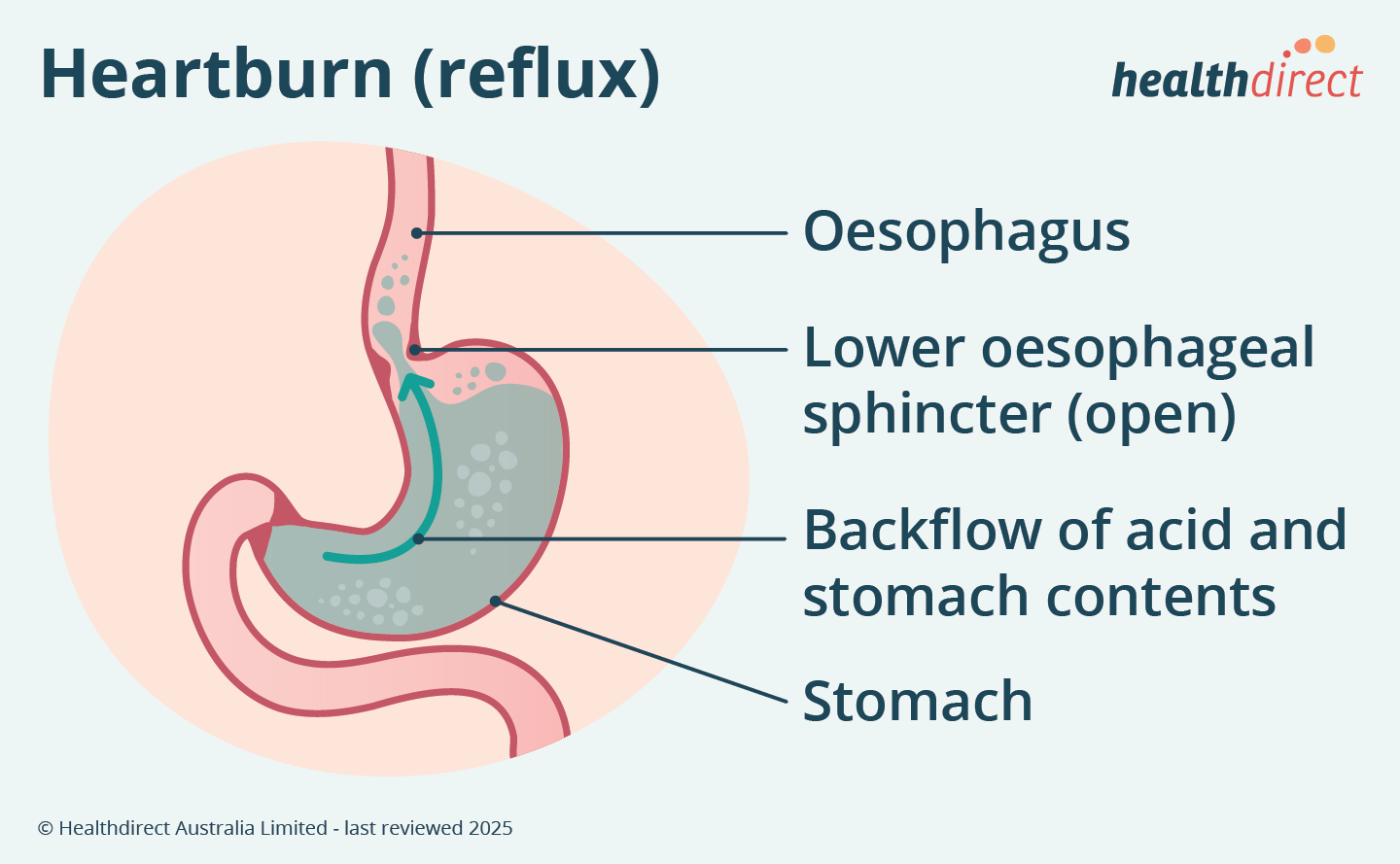
Heartburn happens when acid from your stomach refluxes into your oesophagus.
Some people get heartburn no matter what they eat or drink. Others find they only get it after eating certain foods or meals.
Common food and drink triggers for heartburn are:
Smoking cigarettes can also trigger heartburn.
Other things that can increase your chance of having heartburn or that can make it worse include:
If you experience chest pain and unsure if it's heartburn or a heart attack, call triple zero (000) immediately and ask for an ambulance.
If you have heartburn regularly, like 2 times a week or more, see your doctor. This could be a symptom of gastro-oesophageal reflux disease (GORD).
Also see your doctor if over-the-counter medicines do not help your heartburn, or you rely on them often.
You should also see your doctor if you experience:
Your doctor will often be able to diagnose heartburn by asking questions about your symptoms and what triggers those symptoms.
In some cases, usually when symptoms are not responding to treatment, your doctor may recommend you have a gastroscopy.
This test involves a long, thin tube with a camera on the end being passed through your mouth and oesophagus into your stomach. This happens while you are asleep.
A gastroscopy lets your doctor see inside your oesophagus and stomach. Your doctor can also take biopsies (small tissue samples) during this procedure.
Most people have heartburn from time to time.
If you have heartburn, your doctor will probably recommend diet and lifestyle changes.
If you take medicines for reflux, you should make diet and lifestyle changes as well.
Heartburn that is mild and occasional can usually be managed with lifestyle changes:
If your symptoms don't get better with these changes, using antacids or other acid-reducing medicines can help.
You may try over-the-counter medicines called antacids, which neutralise stomach acid.
Check with your doctor or pharmacist before taking medicines for heartburn. Ask them how to take these medicines to relieve your symptoms.
Ask your doctor or pharmacist if these medicines are safe for you to take if you are:
If lifestyle measures and antacids have not helped your heartburn, short-term treatment with medicines that control stomach acid may be helpful. These medicines include proton pump inhibitors (also called PPIs).
You can buy PPIs in low doses over the over-the-counter from your pharmacy. Your doctor will be able to prescribe a higher dose PPI.
PPIs work best when you take them about 30 to 60 minutes before a meal.
Taking PPI medicines for longer than recommended for heartburn (usually more than 8 weeks) can increase your risk of side effects. Many people take heartburn medicine even when they don't really need it. They also take them for too long.
Some people can take these medicines occasionally, just when they have symptoms. You should talk to your doctor about taking the lowest dose of medicine needed to control your symptoms.
Talk to your doctor about any medicines you are taking for reflux or heartburn to see if it is safe to reduce or stop them.
Histamine receptor antagonists (also called H2 blockers) might be recommended for people who can't take proton pump inhibitors. These medicines also reduce the amount of acid in your stomach.
Anti-reflux surgery is occasionally recommended for more serious cases. It is usually only recommended if:
Acid reflux and heartburn can be related to problems such as:
These problems can also have other causes, so see your doctor if you have symptoms that are troubling you.
You can find out more about heartburn and reflux (Opens in new tab) at the Gastroenterological Society of Australia.
You can also call the healthdirect helpline on 1800 022 222 (known as NURSE-ON-CALL in Victoria). A registered nurse is available to speak with 24 hours a day, 7 days a week.
The Royal Women's Hospital Victoria offers translated information about coping with heartburn during pregnancy (Opens in new tab) in several languages.
Find out how we develop and review our content.
Last reviewed: September 2025

Worried about your health?
Select a symptom, answer some questions, get advice
