Cardiac catheterisation | Children's Health Queensland
Cardiac catheterisation can be used to help diagnose heart conditions, help plan future treatments and carry out certain procedures.


Cardiac catheterisation is a common procedure used to diagnose and treat some heart conditions. Most people are awake during the procedure and many can go home the same day.
A cardiologist (heart doctor) inserts a thin and hollow tube, known as a catheter, through a blood vessel in your groin or wrist and guides it up into your heart.
Cardiac catheterisation allows doctors to check how well your heart, blood vessels and heart chambers are working. In some situations, you may be able to go home the same day.
Cardiac catheterisation is a procedure that can diagnose and treat heart conditions such as:
Cardiac catheterisation can help your doctor plan the best treatment for your heart condition.
Cardiac catheterisation is a common procedure performed by specialist doctors with monitoring before, during and after.
Before the procedure, your doctor will give you specific instructions about how to prepare. You may need to have tests to check your general health, including blood tests to check your kidney function and iron levels and an ECG (electrocardiogram).
If you take blood thinning medicines, you may need to stop them a few days before the procedure or take an alternative medicine. Your doctor will give you specific advice based on your situation.
It's a good idea to ask your doctor any questions you may have about your procedure to help you make an informed decision.
Cardiac catheterisation is done by a cardiologist (specialist heart doctor) and can be done as an outpatient (so you don’t stay overnight in hospital) or as an inpatient in a specialised heart clinic. Your doctor will make a recommendation that suits your situation best, and may also depend on the services available near where you live.
There are some things to consider the day before and on the day of your procedure. These include:
The staff will shave and clean the area where the catheter will be inserted.
Read about how to prepare for surgery and your healthcare rights.
Your cardiac catheterisation will be performed by a specialist heart doctor (cardiologist). Most people are awake during the procedure. Cardiac catheterisation usually involves the following steps:
Let your doctor know if you feel any discomfort in your chest during your procedure.
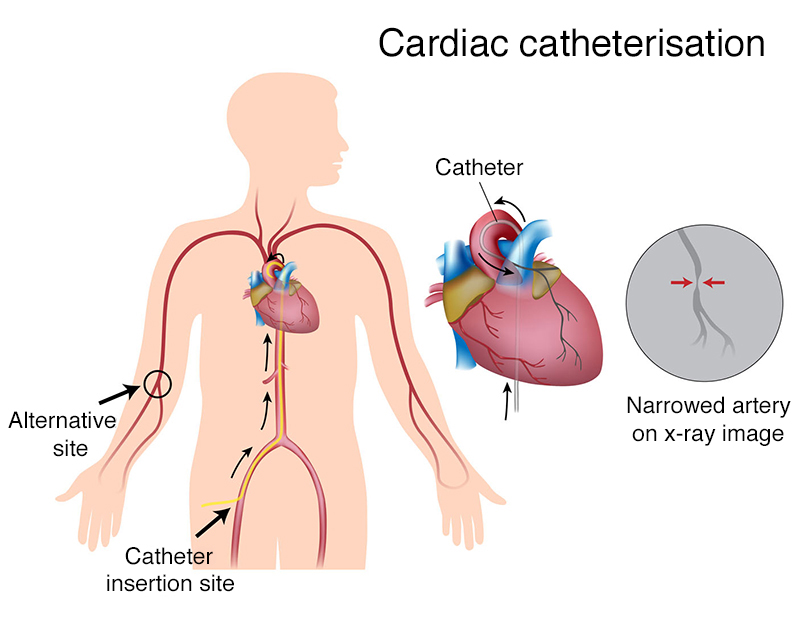
The doctor will insert a catheter in an artery or vein, usually in your groin or in your arm or neck. The catheter is then threaded through your blood vessels to your heart. After the procedure, the sheath is removed from the groin and the artery is closed.
Staff will take you to a special ward where your heart rate and blood pressure will be checked. A nurse will check for bleeding from the catheter site in your wrist or groin.
You will need to rest for a while, and you can eat or drink when you feel ready.
If dye was used, your urine may be monitored to make sure your kidneys are not having a reaction to the dye.
If your doctor performed any interventions during your procedure, such as inserting a stent, you may move to a different ward for an overnight hospital stay.
Your health team will advise you when to start taking your regular medicines again. They may also prescribe new heart medicines. It is important that you take your medicines as your doctor prescribes.
Because you can’t drive yourself home, you will need someone with you when you leave the hospital.
Your doctor will advise you when you can return to work and normal activities, depending on the type of procedure you had. Avoid straining or lifting anything heavy for a week.
Your clinic will also explain which symptoms to look out for and when to call your doctor.
Learn more about staying healthy when you have a heart condition.
When you are back at home, if the puncture site bleeds uncontrollably or swells up quickly, call triple zero (000) and ask for an ambulance.
Cardiac catheterisation is usually done under local anaesthetic, except in children, where it is usually done under general anaesthetic.
You may feel some warmth when the dye is injected into your blood vessel.
Minor complications after cardiac catheterisation are rare, but can include:
Major complications are rare but can include:
Cardiac catheterisation is a common procedure that is generally considered safe.
Depending on your situation and health condition, your doctor may discuss other types of imaging to assess your heart, such as ultrasound (echocardiogram), magnetic resonance imaging (MRI) or computed tomography (CT) scan.
If your procedure is delayed for any reason, contact your healthcare provider. They can help manage any changes to your medicines made in the lead-up to your procedure and reschedule your procedure.
Visit the Heart Foundation (Opens in new tab) website to learn about other heart procedures.
Book a Heart Health Check (Opens in new tab) to learn your risk of heart attack or stroke.
Learn more about healthy eating to protect your heart (Opens in new tab).
St Vincent’s Hospital has information on coronary angiograms (Opens in new tab).
The Heart Foundation has information on heart health (Opens in new tab) available in many community languages.
Safer Care Victoria has resources available on your surgical journey (Opens in new tab) in several community languages.
The Heart Foundation has an animation on having a heart check (Opens in new tab) for Aboriginal and/or Torres Strait Islander peoples.
Find out how we develop and review our content.
Last reviewed: May 2026
Worried about your health?
Select a symptom, answer some questions, get advice